





Eye For Film >> Movies >> Hidden In Frame (2026) Film Review


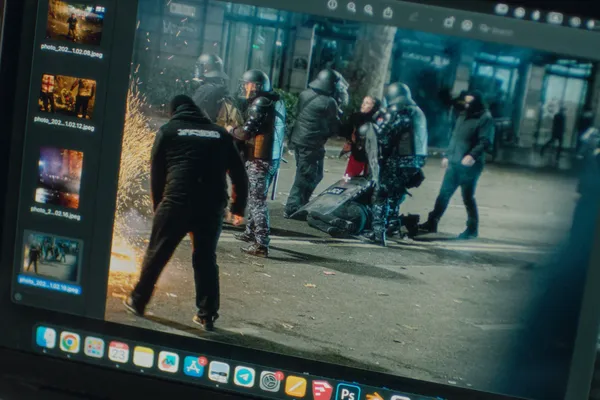

For the past few years, protesting has become almost a way of life for a significant part of Tbilisi’s population. It was only a matter of time before this reality made its way into contemporary Georgian cinema. This year, several films at Kutaisi International Short Film Festival have placed the protests at the centre of their stories. Anna Sarukhanova’s Hidden In Frame is one of them. It is an encouraging development that Georgian cinema is engaging directly with a reality inseparable from everyday life. But political relevance is not an artistic achievement in itself. The challenge is to find a cinematic language capable of doing justice to such a familiar experience. Unfortunately, Hidden In Frame too often substitutes melodrama for observation, ultimately undermining the very political relevance that makes its subject matter so compelling.
Nata (Tina Eradze) returns from abroad to her late grandmother’s flat in Tbilisi, where she discovers that a girl named Tiko (Taisia Eradze) has been secretly staying. As a protest participant and photographer, Tiko is hiding from the police. The premise offers fertile ground for exploring family estrangement against a backdrop of political turmoil. However, in this case, it pushes the story towards soap-opera territory. In 17 minutes, the film piles on repression, fear, reconciliation and tragedy. Melodrama can be a powerful way to explore political and personal upheaval, but here it becomes a shortcut to emotions the film has not earned. Everything is heightened before anything has been sufficiently developed.
The dialogue compounds the problem. The characters sound as though they are delivering lines written to communicate the film’s themes rather than speaking to one another. The resulting artificiality places an unnecessary burden on the actors, whose performances struggle to make these exchanges feel spontaneous. For a film concerned with recognisable Georgian realities, its failure to capture the rhythms of everyday speech is particularly conspicuous.
This raises a broader question about contemporary Georgian cinema: who are these films speaking to? Are filmmakers attentive to the audiences who share the realities they depict, or are they packaging recognisable local circumstances for international funders and festival circuits? International financing is not inherently incompatible with local authenticity. But when characters feel disconnected from the society they supposedly inhabit, Georgia risks becoming less a lived reality than a convenient backdrop. A film should be able to travel beyond its borders without making its own country feel foreign to the people who live there.
An arrest scene exposes the gap between the film’s ambitions and its execution. As the personal and political tensions converge, the film struggles to convey the lived reality of state repression. Many of us have taken part in protests and witnessed arrests firsthand; we know the confusion, panic, violence and terrifying unpredictability that accompany the exercise of state power. Yet the scene conveys little of this emotional and physical reality, treating the arrest primarily as a dramatic turning point. Fiction need not reproduce events literally, but it must make their consequences felt.
Curiously, Shalva Sokurashvili’s cinematography understands the scene better than the screenplay or direction. A low-angle shot frames the arrest between two looming buildings, creating a claustrophobia the action itself never conveys. There is something almost German Expressionist about the composition: the looming buildings distort the sense of space, turning the urban landscape into an extension of the characters’ psychological distress and the oppressive force of the state. The image communicates a sense of entrapment that the staging itself struggles to convey. In fact, the cinematography is so much more expressive than the action that the scene might be more effective without its dialogue.
The growing presence of the protests in Georgian cinema is welcome. The next challenge is to do more than put them on screen.
Reviewed on: 23 Oct 2026